Limak Hotels – Brand Blog
Antalya's Most Beautiful Places to Visit
Antalya's most beautiful places range from ancient Lycian cities perched in pine forest to coastal coves where Roman harbours still hold their shape. The region rewards those who move beyond the resort zone — into ruins, waterfalls, mountain villages, and shorelines that most visitors never reach.
Beauty here is layered. Roman stone beneath Ottoman plaster. Limestone cliff above turquoise water. Mountain range above coastline. The ruins are more striking for their natural settings; the coast more striking for its ruins. This is not a region that reveals itself to the hurried traveller. Its most extraordinary places sit at the end of roads that require decision and direction.
This guide identifies where that layering is most complete — where the beautiful places in Antalya reveal themselves not to the hasty, but to those who arrive prepared to look.
What Makes Kaleiçi One of Antalya's Most Visually Striking Areas?
Kaleiçi is Antalya's oldest quarter and its most visually concentrated. Roman walls, Byzantine towers, Ottoman houses with carved wooden balconies, and a natural harbour in continuous use for two millennia — all within walking distance of each other.
The Yivli Minaret, built in the 13th century by the Seljuk Sultan Alaeddin Keykubad, rises above the roofline in fluted brick — one of the most recognised silhouettes in southern Turkey. Nearby, Hadrian's Gate — erected in 130 AD — stands as one of the best-preserved triumphal arches in the ancient world. To pass through it is to understand, without explanation, what it means for a city to carry its own history in stone.
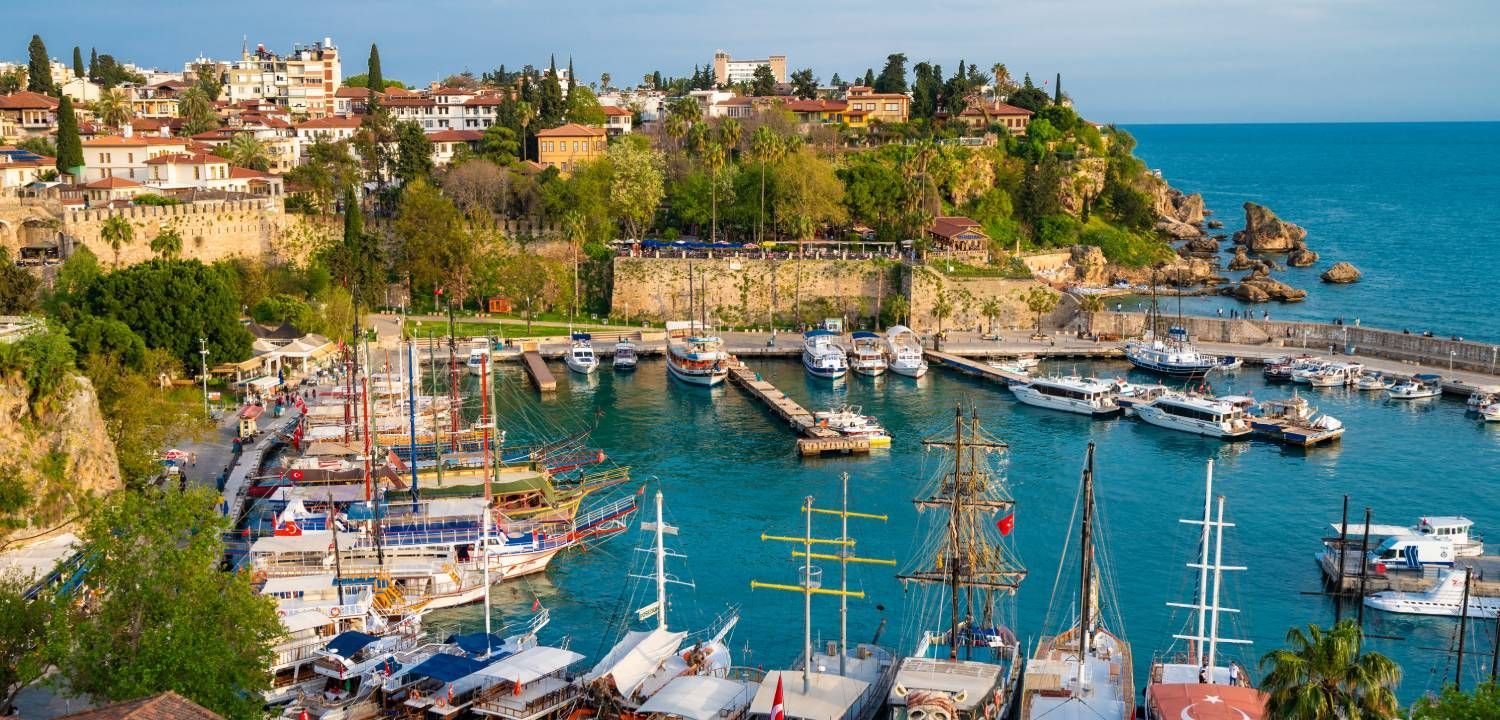
The harbour below is best seen at first light. Fishing boats, fortified walls, and the reflection of the old city in still water — an image that needs neither filter nor caption. Return at evening, when the western light turns the harbour walls a precise amber, and the same scene offers something entirely different.
Why Is Phaselis One of the Most Beautiful Ancient Sites Near Antalya?
Phaselis occupies a narrow peninsula with three distinct bays — each sheltered, clear, and edged with the ruins of an aqueduct, a theatre, and colonnaded streets. The site is enclosed within pine forest that grows directly to the shoreline. Its shade falls across broken columns and mosaic fragments in a way that no restoration could improve.
Alexander the Great wintered here in 333 BC. The city gave him its keys without a siege.
Swimming with marble blocks visible beneath the surface is an experience particular to this coast. The combination of Antalya ancient ruins and clear water makes Phaselis singular among the region's archaeological sites. The ruins and the water exist in the same register — equally clear, equally old, equally indifferent to the distinction between history and pleasure.
Arrive by mid-morning. Bring enough water for several hours. The site is large and the shade is intermittent.
What Are the Most Scenic Natural Landscapes in the Antalya Region?
The Düden Waterfalls divide into two separate sites. The upper falls are surrounded by parkland. The lower falls, on the coastal cliffs east of the city, drop directly into the sea — seen from the water by boat, a ribbon of fresh water descending a sea cliff into the Mediterranean, framed by rock that turns orange in the afternoon light.
Saklıkent Gorge, 50 kilometres from Antalya, is one of Europe's longest canyons. The Eşen River runs through it cold and fast year-round. The gorge walls rise over 300 metres, cutting the sky to a narrow channel above. The cold is immediate and absolute — a form of relief that no hotel pool can replicate.
Köprülü Canyon National Park offers ancient stone bridges, dense pine forest, and a river used for rafting through limestone gorges. The park's Roman bridge, the Oluk Bridge, has been in continuous use since the 2nd century AD. That continuity — two thousand years of crossings — reframes the experience of standing on it. This is not a relic. It is a road.
Which Coastal Views Around Antalya Are Worth Seeking Out?
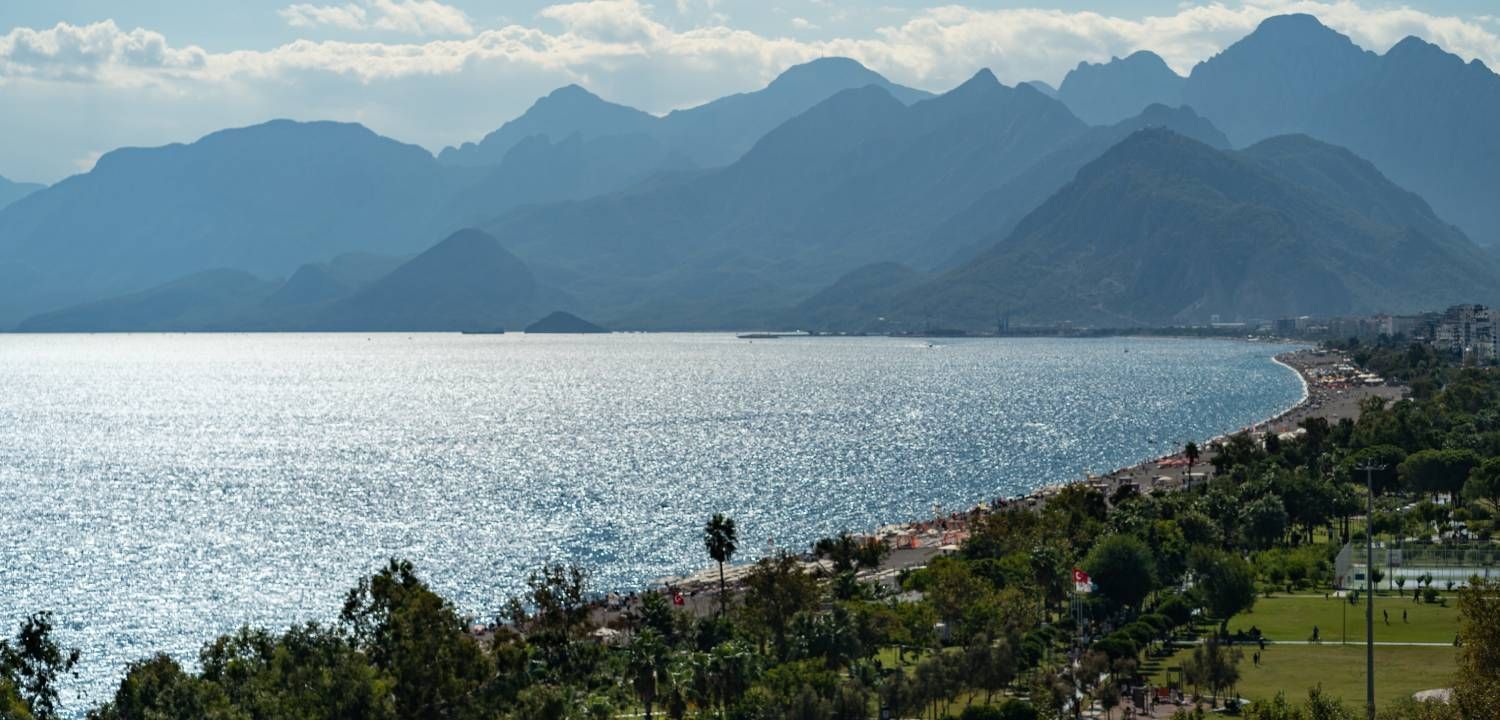
The clifftop platform above Konyaaltı Beach, where the Taurus Mountains descend directly to the shoreline, offers a view that defines the Antalya coastline in its most dramatic form. Sky, mountain, and sea arranged in vertical layers — with no room for the landscape to become ordinary.
Olympos, accessible through a valley of ancient ruins, is a coastal experience without parallel in the region. Protected from development by its archaeological status, the beach remains as it has always been — pebble, pine, clear water, with partial Lycian city remains rising from the undergrowth. To walk to the beach at Olympos is to move through a living ruin that the forest is slowly, patiently reclaiming.
Kaş, further west, is the region's most considered small town — terraced above a natural harbour, with Lycian rock tombs cut directly into the cliff face above the main street. The view from the hilltop theatre, across the harbour toward the Greek island of Meis, belongs to a category of views that requires no further commentary.
Discovering the Taurus Mountains Above Antalya
Termessos sits at 1,050 metres, inside a national park, surrounded by cedar and pine. The Pisidian city was never conquered — its mountain position made attack impractical even for Alexander. What remains is a theatre, a gymnasium, five necropolises, and a silence that the altitude preserves.
The theatre is among the most affecting in the ancient world — not because of its scale, but because of its position. The seats rise on a natural slope; the stage opens onto a view of the valley below and the coastal plain beyond. To sit in the upper tiers is to understand why the Greeks located their theatres with such deliberate care. The view was never incidental. It was part of the work.
The mountain villages along the route — Çakırlar, Düzlerçamı, Gebiz — operate at a pace and on a scale that the coast no longer offers. They are part of the transition that makes Termessos comprehensible. The altitude earns the view.
Stay at the Heart of It All with Limak Hotels
Antalya's most beautiful places are best approached from a position of genuine comfort — not the comfort of removal, but the kind that restores. A base matters. Those who stay in the right location move through the region's sites with ease; those who don't spend their best hours in transit.
Limak Lara De Luxe Hotel & Resort places guests on Lara Beach, within reach of every site described above. The beach is wide, well-maintained, and bordered by clear water. The distance to Kaleiçi, Phaselis, Köprülü, and Termessos — all within the range of a well-organised day.
For those searching for Antalya hotels that match the region's natural and historical depth, Limak Hotels is the answer worth considering.